
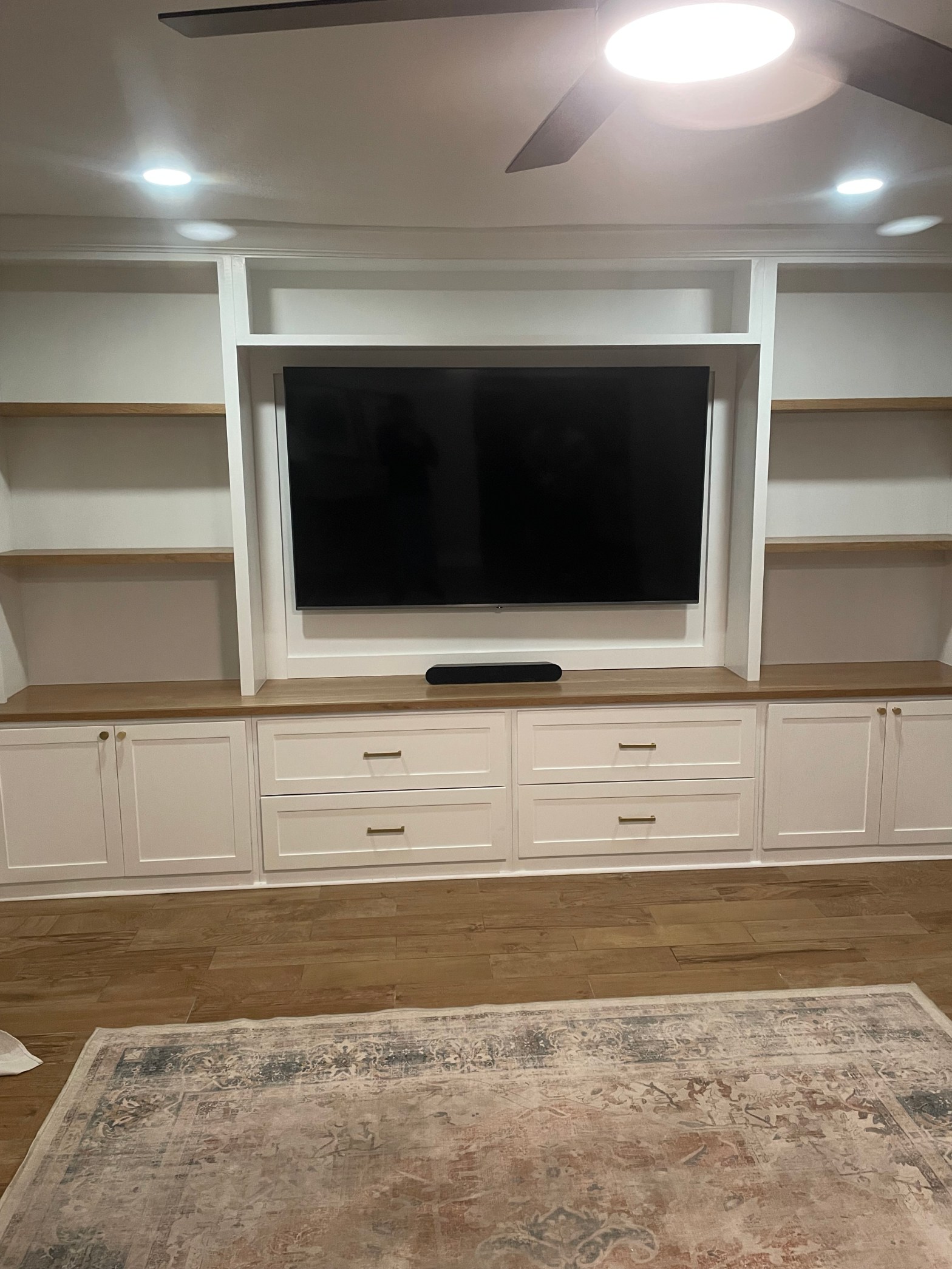
I’ve been making cabinets professionally for a decade now, and I’ve learned a lot. I’m gonna tell you. Five mistakes that you need to avoid to make sure that you can make professional quality doors, even with DIY tools.
Alright, before we start building our cabinet doors and talking about the mistakes that happen, let’s first talk about the parts of a cabinet door. There’s three main parts in a cabinet door. These simple shaker style doors typically have your rails, your styles, and your floating panel. With the rails and styles, we’ll all receive a mortis, or a dado. That is a hole that’s gonna accept that floating panel. So all four pieces need to have that.
The pieces that are going horizontal will also get tendons. The tendons then fit into the mortis and will be glued together. The panel goes into the mortis on all four pieces and the tendons will slide into the mortis. Alright, so we’re talking the five mistakes that cabinet makers make, especially on the DIY side. If you’re just getting into it, you’re starting your business or you need to build some cabinet doors for a project at the house.
The first mistake that most people make is they’re not working with pieces that are the same thickness. You have your rails and your styles, but if they’re the different thickness, you’re gonna be in trouble at glue up because now you’re gonna have one thing sticking up a little bit higher than the other, and now all of a sudden you gotta sand it.
And sanding takes forever. Nobody likes to do sanding. So make sure that it’s right the first time before you glue it up, run ’em through the planer, run ’em through a joiner, whatever you need to do to ensure that they’re the same thickness. That way when you go to glue it up. Everything’s gonna go smooth.
If you don’t, I’m telling you, I’ve made this mistake before. You have one thing that’s sticking up a little higher than the other side. And now you’re gonna go to sand it and you’re gonna hold that sander on there and make the mistake of sand in that spot. Well, now you’re gonna end up with a little ridge right there.
All right, so the second mistake that so many people make is they don’t make sure that they have a flat edge on the rails. When you’ve got the rails, oftentimes your stock material will not be perfectly straight. You wanna run it through. Either on the table saw or you just make sure that you straighten that piece up.
Or if you have a joiner, run it through there. You wanna make sure this is flat, because if this is not flat, then this joint. It will not go together smoothly. It’s slightly shorter. Now all of a sudden you’ve got a gap. You don’t want those gaps. They’re pain in the butt to fill. When you do fill ’em, you gotta sand them like crazy. And that goes back to our mistakes before. If you make a mistake, you’re gonna pay for it later when you’re doing the sand.
The next mistake that’s so many people make is they make their mortises either too big or too thin. You want it to have a nice snug fit. It should not be too loose where it’s flipping flopping around and you don’t want it to be too tight that you can’t get in. If you have to jam it in, you’re gonna end up putting a lot of stress on the outside Now, depending on the type of panel that you’re using. You have to account for some wood movement.
I use MDF panels for my floating panels on the shaker doors because it’s getting painted. MDF paints a lot better than quarter inch plywood. You tend to get some bubbling sometimes in the plywood, but you don’t have that problem with MDF. You get a nice smooth finish. MDF is not gonna move because it’s not real wood.
If you’re doing a wood floating panel, you have to account for wood movement, so you want it a little looser. It’s gonna accept moisture and it’s going to expand and contract over time. Humidity changes. Take all that into account. Make sure you get a nice snug fit for your floating panel.
If you do have a router table, get yourself a pair of these bits, right here: (https://amzn.to/3UnjobM – Cabinet Door Router Bits) You have your mortis bit and you have your tenon bit. The two bits work together to give you a perfect mortis and tenon. That’s what you’re going for. That’s if you have a router. If you don’t have a router table, that’s not a problem.
Don’t worry about that. You could do all of it on a table saw. I have a video. This video shows you how: (https://youtu.be/kzFS__wt7k8). How to make cabinet doors with nothing but a table saw. It’s great. Most people don’t have a router table. It’s a little bit more on the professional side of things, but most woodworkers, if you’re taking it this seriously, have a table saw.
Mistake number four, so many people make this mistake and I used to make this mistake when I first started and it’s killer. Why don’t you take a look at this? You have to stand in this after it’s been glued up, right? Everything needs to be sanded.
Sand the floating panel prior to assembly. This is very important to ensure that you get a smooth finish. Trying to sand the corners of the panels once everything is glued up is near impossible.
You should be ready to finish it before you glue it up. Sand this first so you don’t have to sand those corners later. I’m telling you, man, no matter what little trick you think you’ve got, sanding those corners is near impossible.
Let’s get to the last one. I’m telling you so many people make this mistake.
It’s the worst. Here’s the last mistake that you do not wanna make. Mistake number five. Don’t glue this in this right here. Has to stay floating. If you glue this in, you’re going to have problems even with the MDF, right? Like I said before, MDF doesn’t move, but the wood that you’re using on the outside does when the movement happens later, this is not gonna move, and you’re going to get cracking in these.
Now the reason this is a kind of a big common mistake, and the other thing I’ll see a lot is caulking along here. That stuff’s gonna crack in the long run. You wanna know why it’s gonna crack because this moves, and if this doesn’t. So if this moves and this doesn’t, you’re gonna have cracking manufactured doors that you find.
Now. They are completely MDF custom cabinets. We charge a premium. The reason we charge a premium is ’cause this is maple. This is real wood that we’ve made. And then the only thing that’s not real wood is panel. And again, that’s for finishing purposes, but that means that you should not have connection here.
Thanks for reading. Make sure that you like and subscribe. Share this with your cabinet buddy. Share this with your wife who says, Hey, I want you to caulk the edge. Don’t do it. Go out there and make yourself some cabinets. We’ll catch you next time. Crafted in Florida.
Discover more from CRAFTED IN FLORIDA
Subscribe to get the latest posts sent to your email.
 CRAFTED IN FLORIDA