
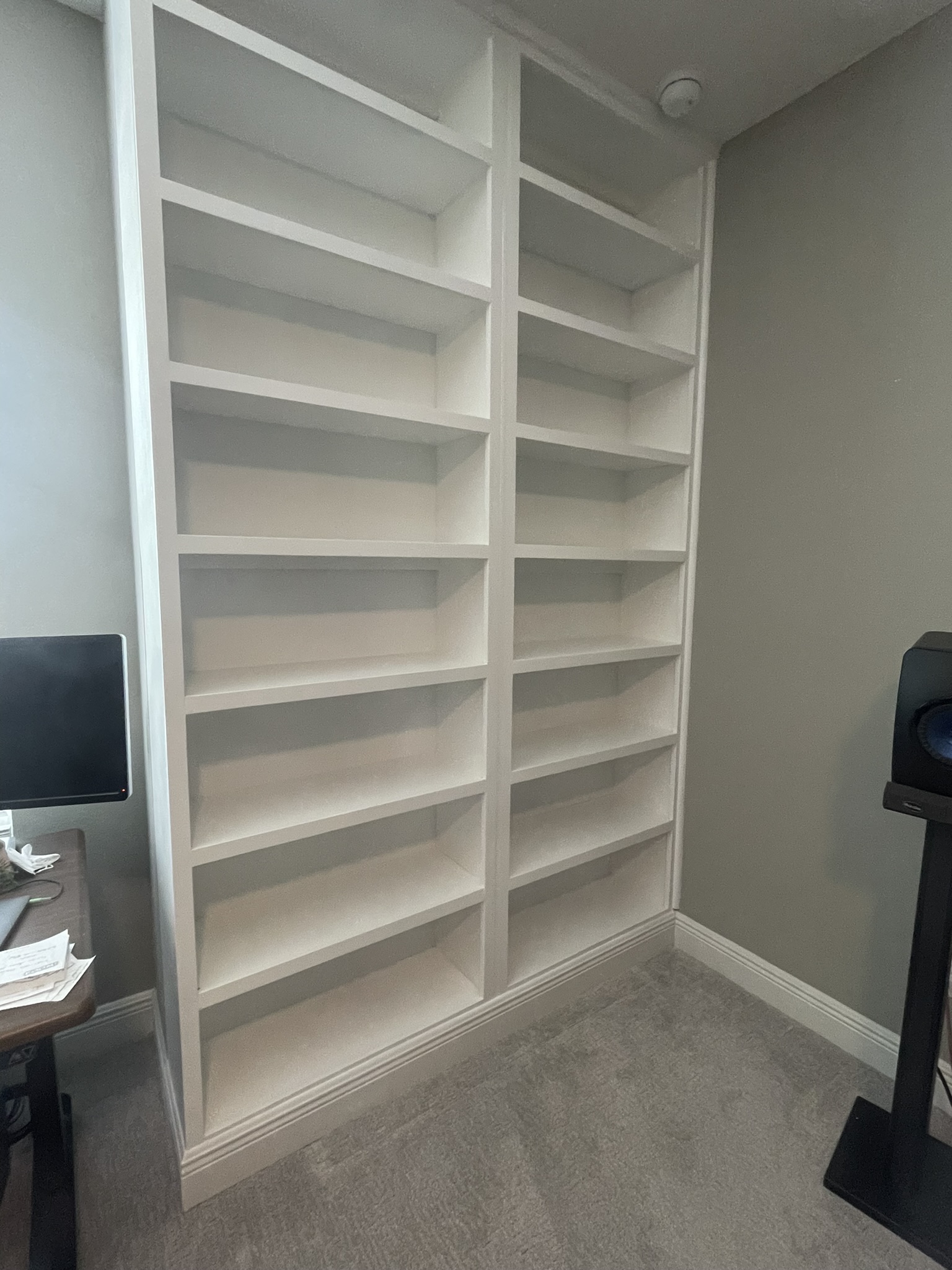
One of the most common carpentry projects that a DIY’er would take on is a bookcase or open shelving. Bigger bookcases can be intimidating, but it shouldn’t deter you from taking on this project. Open shelving is simple in that you want to make sure the shelves are supported on all sides. I’m going to take you through the steps I went through to build a pair of 9’ bookcases for a client.
The first thing that I did was map out the location of my shelves. It’s important during this process to take into account the thickness of the shelves. For example if you’re going to have 5 shelves on your bookcase and the shelves are ¾” thick, take the height of the bookcase minus the 3-¾” of your shelves and you’ll be left with the space between your evenly spaced shelves. Once you’ve mapped out the location for your shelves, I like to dado out the shelves so that the shelves will sit inside those dados. I achieved this on a large piece of wood by setting up my track saw and making sure the blade is lined up on the inside of the lines. I made those cuts and then pulled out my router to clear out the remaining portion of the dado. I repeated this process for all of the shelves.
The next step was to then rip the dadoed sheet of plywood into the depth of the bookcase. I also cut the shelves and top of the bookcase while I had the table saw set up at the correct width. This is a good tip to keep in mind, make the cuts that are the same width all at the same time so you are consistent. Once all of the plywood is cut, I turn my attention to the face frame. I’m using poplar for the face frame and will cut rabbets in all of the face frame pieces to accept the shelves and the uprights of the bookcase. I set the depth of the rabbet to the same thickness of my back panel, and set the height to the thickness of the shelving material. I run the pieces through twice to ensure the shelf sits smoothly in the rabbet.
The face frame then gets assembled with pocket holes, glue, and screws. Then attached to the carcass with glue and brad nails. I then dry fit my shelves to make sure they sit how I want them. Once the test fit is complete I can add glue and put them back in place and attached with brad nails. The back panel would get attached on site as it’s much easier to move around without the back panel on. Nailers were added on the back side of the shelves to attach to the wall. The nail holes are filled with spackling and the entire thing is sanded, primed, and painted with cabinet grade paint. The bookcases were delivered, moved up stairs and installed without issue.
Thank you for reading this article, watch the video for more visuals and information. Please like and subscribe so you can stay up to date on the latest from Crafted In Florida. You can also follow us on any of the social media platforms for short and long form clips @Crafted_In_Florida on YouTube, Instagram, Tik Tok, and Crafted In Florida on Facebook.
Discover more from CRAFTED IN FLORIDA
Subscribe to get the latest posts sent to your email.
 CRAFTED IN FLORIDA