
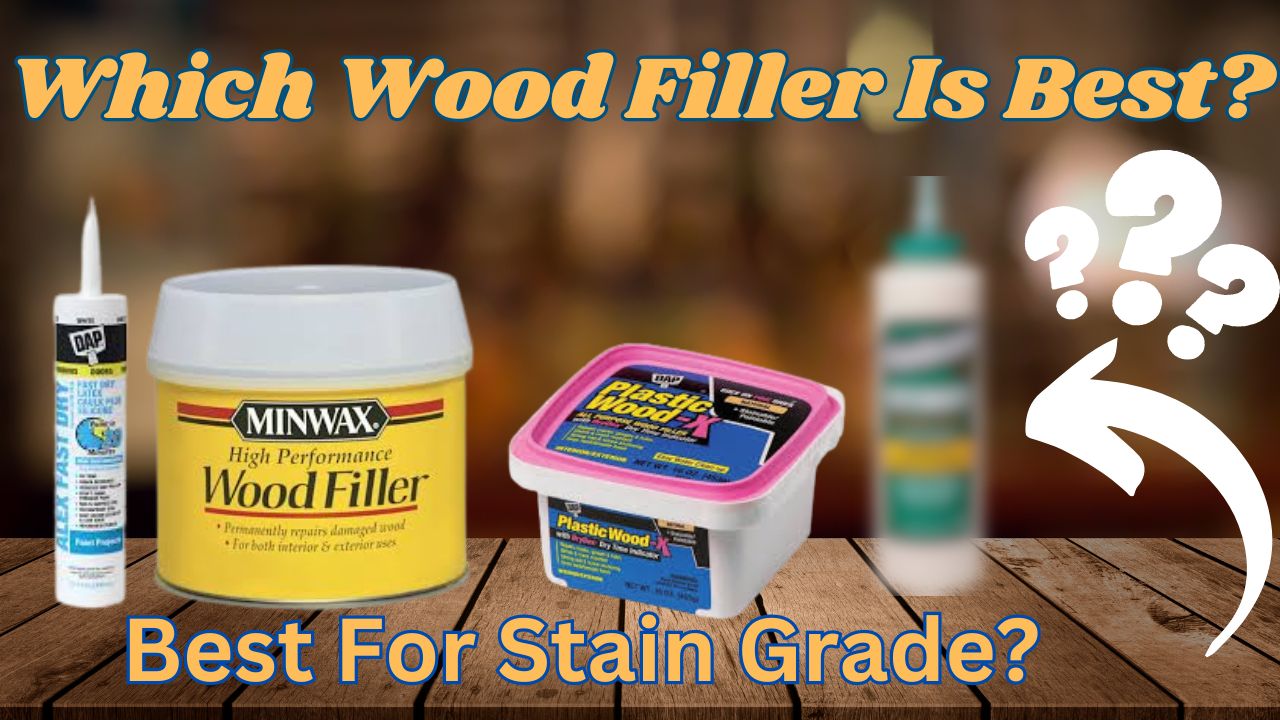
If you’ve done any kind of wood working or trim carpentry you know that there will be holes and or seams that need to be filled. There is an old saying among trim carpenters; “Caulk and paint, make it what it ain’t”. Now doing fine furniture work and trim carpentry for nearly a decade now I’ve learned different products that are better at filling holes and others that are better at seams. Here are the top 5 products I like to use and the situation that I use them for.
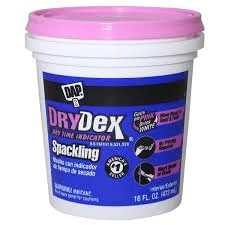
The first product that I like is Dap’s Dry Dex Spackling which is like the name suggests a spackling not a wood filler. I only use this for paint grade projects and primarily to fill nail holes in the wood. This product has a dry indicator which is a great feature. I like to fill the holes a little proud of the surface and let it dry, before lightly sanding it smooth. I’ve had a lot of success with this product when doing baseboards and crown molding.
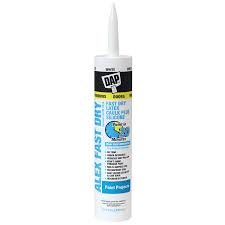
The second product is caulk. This is a must have in a carpenter’s tool box. Caulk is used to fill seams between two pieces, primarily caulking trim pieces to walls. Caulk comes in many different colors and even clear, but most often it comes white and will accept paint well once it dries. Caulk is great for the trim pieces and seams, but I’ve found it tends to shrink when it dries, so be sure to leave the caulk a little proud of the surface so that you can come back later to sand it smooth.
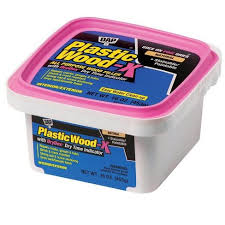
The third product is plastic wood by minwax. This product is similar to the spackling, but when it dries it dries in a light wood shade opposed to white. This product advertises as a stainable product, but I’ve found it does not absorb the stain very well and it is very obvious when you put stain on the piece. It does a good job of filling the hole and if you were painting the piece it would be fine, but if you’re going to paint the piece then you might as well use the spackling that dries white and wouldn’t need the primer.
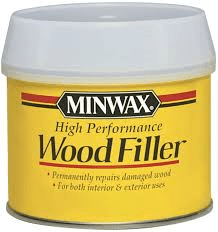
The fourth product is minwax high performance wood filler. This would be similar to Bondo, a popular filler used in auto body shops. This product is a two part product that you mix as needed, it comes with the filler and a small squirt bottle of hardener. This creates a stronger end product that would allow you to fill larger cracks and holes. Like the plastic wood, this product advertises as stainable, but I’ve found through testing that it does not take stain well. I think it is a superior filler if you need the piece to be durable, great for a high traffic piece like a cabinet door but it doesn’t take stain well.
The final product is the one that I believe takes stain the best, and that’s because it is made from the wood that you’re using. Mixing sawdust from the cutting and sanding of the wood with some wood glue will give you a mixture that will match the tone of your wood very well. The way I like to create this mixture is be adding a glob of glue to a scrap piece and pour a good amount of sawdust onto that glue, using a stick or putty knife to mix it up and then apply to the needed areas. Then before you let it dry, drop some more sawdust on top of the area and rub it in a little bit to let it dry. Then sand it smooth after the glue has dried. This will accept stain better, and I believe is best used for nail holes, cracks in the wood, and bug holes.
Remember if the hole is bigger than ¼” you will have a better chance making a smooth repair with an inlay. For all of the products you will have more success but over filling the holes and letting it dry, then sanding it smooth. I hope this was informative and helps you on your woodworking projects!
Thank you for reading, and if you haven’t yet please subscribe so you can be notified whenever we post a new article or upcoming news!
Discover more from CRAFTED IN FLORIDA
Subscribe to get the latest posts sent to your email.
 CRAFTED IN FLORIDA